
Your technician fixed the air-con.
Can you prove every baht on the bill?
In Thailand, that question matters more than it should. Customers have learned to fear the surprise air-con bill, and honest shops end up paying for that fear too. This article looks at why, and at four habits that let a service business show exactly what it did, what it used and what it charged.
We'll follow one job at Rob's Cool Air, a made-up Bangkok shop we built in Odoo for our October demo.
Prefer to watch? The whole job takes five minutes.
The surprise bill
Thai news has covered it more than once. In 2020, Matichon reported on an elderly customer billed 7,320 baht after a technician, called in to clean the air-con, topped up the refrigerant in all three units. The family said two of the units had been cooling normally, and that their CCTV showed no price was ever discussed. In 2022, Naewna reported on a household in Rayong billed 5,800 baht. "The technician didn't tell us anything at all," a relative said. The customer went to the police.
It hasn't gone away. In May 2026, the home-services platform Q-CHANG was advising customers to choose providers that don't add refrigerant unnecessarily.
In both stories, the trouble isn't only the amount. Nothing was agreed first, and nothing was written down. When a bill arrives as one lump sum, the customer can't tell an honest repair from a padded one, so even a fair shop gets suspected. It cuts the other way too: a part that's never recorded can slip off the bill entirely, and then the shop pays for it.
Both problems have the same fix: a record the customer can see, from the first message to the last baht.
1. Agree the price before anyone drives over
The best shops already work this way. Some Bangkok shops advertise a price quoted before every job, and HomePro's repair service quotes parts and labor for the customer to approve before work goes ahead.
At Rob's Cool Air, the job starts with a LINE message from Khun Ploy: แอร์ไม่เย็น, the air-con isn't cooling. Before anyone drives over, the office sends her a quotation from Odoo's Sales app with the likely fix on three lines.
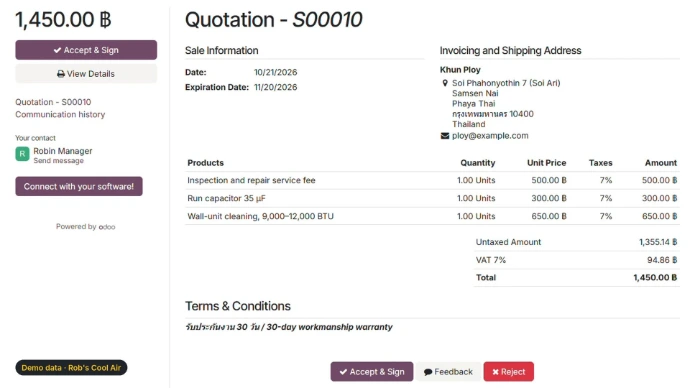
These are demo prices, but realistic ones: HomePro lists a standard wall-unit clean at 650 baht, and a price list based on the Thai Air Conditioning Traders Association's rates puts an inspection at 300 to 600.
Khun Ploy opens the quotation on her phone, sees every line and every price, and signs it online. The price is settled before the van leaves.
2. Put every part on record
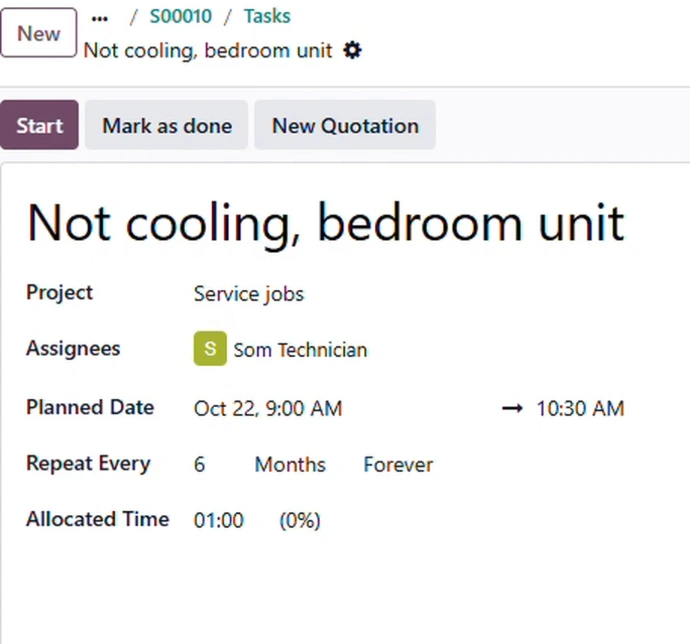
Her signature does more than approve the price. In Odoo, the signed quotation becomes a confirmed sales order and creates the job in Field Service, linked to that order, so nobody types anything twice. The office assigns Som, the technician, for Thursday morning.
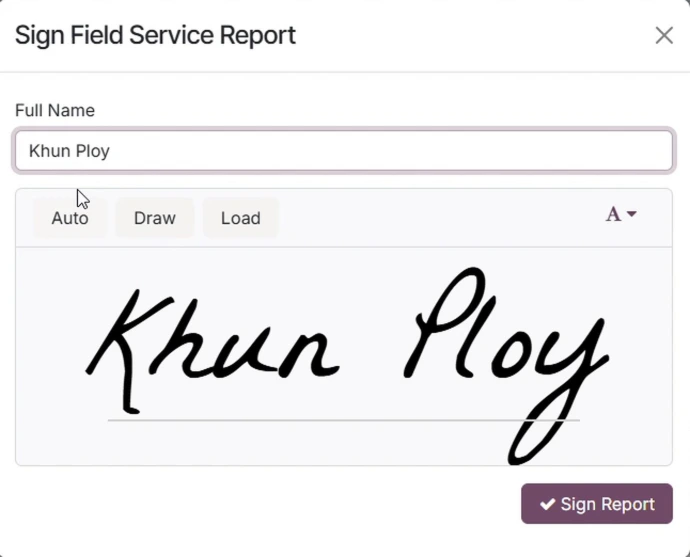
On site, Som starts a timer when he arrives and takes a photo of the old capacitor, so there's proof of what came out. When the work is done, he stops the timer, the time is logged against the job, and Khun Ploy signs off the work on his screen.
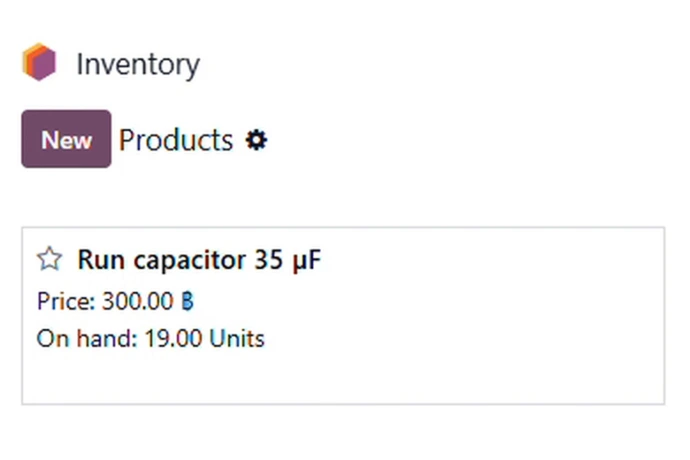
Back at the office, the delivery is validated and the capacitor comes off stock. Twenty on the shelf becomes nineteen, and nobody had to count it.
3. Get paid before the technician leaves
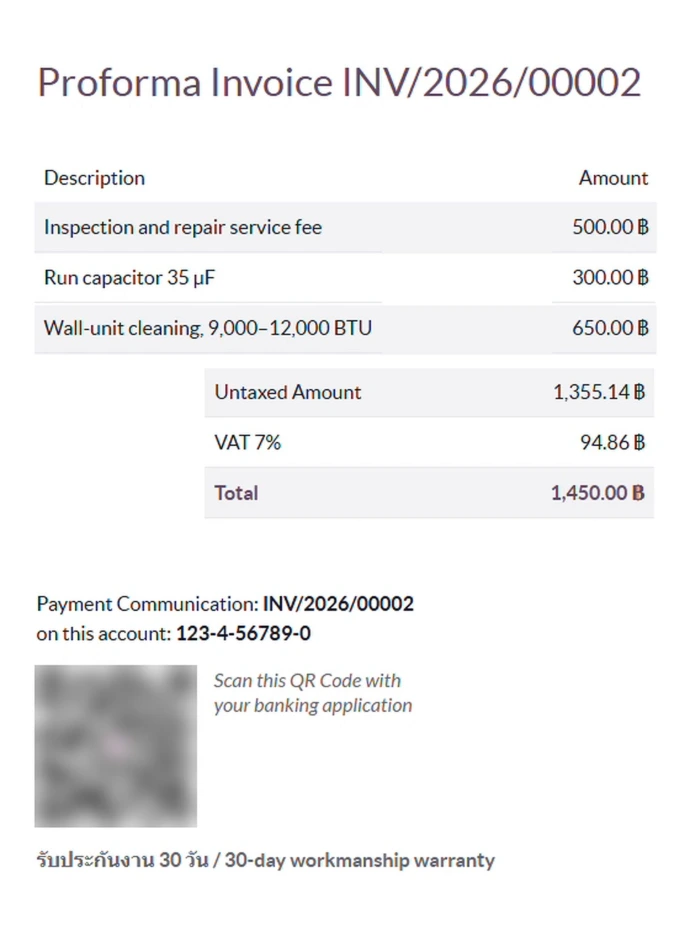
The invoice is created right from the job and built from the quote Khun Ploy signed: the same three lines, 1,450 baht, with the VAT shown. A 30-day workmanship warranty is printed at the bottom, in line with the 30 days HomePro gives on its cleaning.
Her copy carries a PromptPay QR code, which Odoo's Thailand localization can add to invoices. PromptPay averages about 70 million transactions a day, according to the Bank of Thailand, so for most households, scanning is the easiest way to pay. She scans, the payment is registered, and the job is closed before Som has packed up.
A few Thai tax points for the bill:
- VAT is 7%, so a price of 1,450 baht with VAT included holds 94.86 baht of it.
- A full tax invoice on request. The Revenue Department lets repair businesses issue an abbreviated tax invoice, but they must issue a full one whenever the customer asks.
- No withholding tax for a household. Only companies and other juristic persons withhold. A company customer is a different story, for another article.
The families in the news got one big number and no explanation. Khun Ploy got every line, at the price she’d already agreed to.
4. Plan the next visit now
A clean unit costs less to run. EGAT recommends cleaning every six months and says it saves more than 23 kWh per unit a month. So when the office set up Khun Ploy's job, it set it to repeat every six months, and her next cleaning is already in the calendar.
Six months from October is April, the middle of the hot season. In April 2023, with temperatures above 40°C, Matichon reported customers waiting two to three weeks for a technician. Khun Ploy won't be one of them.
Not just air-con
The same four habits fit any business that sends people out to do the work: pest control, CCTV, solar, water filters. The price agreed first, every part on record, paid on the spot, the next visit already planned.
That's how an honest shop proves it's honest.
Every service business runs a little differently, and setting Odoo up around how yours works is what we do at
CU Solution System.
If that sounds like your business, let's talk.