
You've picked Odoo...
So who actually sets it up, and who do you call when something needs fixing?
It's one of the first questions new Odoo customers ask, and a fair one. Running Odoo with a partner means working with two companies: Odoo, which makes the software, and your partner, which makes it work for your business. Knowing where one ends and the other begins saves time, money and a few frustrating emails.
Here's how the work usually splits, based on Odoo's own subscription agreement and pricing page.
Two companies, One system
Odoo SA builds the software and provides the subscription. Your partner is a separate company that you choose to implement and support it. You can change partners, or work with Odoo directly, with 30 days' written notice.
What Odoo does
Builds the software
- A new major version comes out every year, and Odoo's services cover the three most recent ones.
Hosts it, if you want
- Odoo can run your database on its own cloud, with daily backups kept on two continents and 24/7 monitoring. You can also host it yourself.
Fixes bugs and ships security updates
- Odoo fixes bugs in its standard software and starts on a reported bug within two business days. On Odoo's cloud, security fixes are applied for you.
Upgrades your database
- Upgrades are included in every plan: Odoo converts your database to the new version and fixes any bugs the upgrade itself causes.
Supports you by email
- Your subscription includes unlimited email support from Odoo, around the clock Monday to Friday, in English, French, Spanish and Dutch. It covers bugs and questions about Odoo's standard features; help with customizations needs a separate agreement.
Odoo is also open about what its plans leave out: the installation service, access to expert services, and maintaining custom code. That's where implementation comes in, and Odoo offers it both ways: directly, through packages it calls Success Packs, or through local partners.
What your partner does
Learns how your business really works
- Before anything is configured, a partner maps how you buy, sell, stock, bill and report, and where today's process breaks down.
Sets Odoo up to fit
- That means configuring it to your way of working and, where standard Odoo doesn't cover a need, building the customizations and the connections to the systems you already use.
Moves your data and trains your team.
- Your records come across from your old system, and your people learn Odoo on their own day-to-day work.
Stays with you after go-live
- Odoo's upgrade service converts your database, but checking the upgraded system, working out what has changed and adapting anything the service doesn't cover are left to the customer. That's work your partner takes on.
Localized
- Thai language, your time zone, and Thai tax set up right
On Thai tax, credit where it's due: standard Odoo already handles a lot, including 7% VAT, withholding tax, VAT reports for the Revenue Department and PromptPay QR codes on invoices. A partner's job is to set that up correctly for your business, not to reinvent it.
On support, a local partner fills the gap a global help desk can't: support in Thai, from people who already know how your system is set up, including anything built just for your business. If your accounting or warehouse team works in Thai, that matters.
What "set up to fit" looks like at CU
A few examples from how our implementers work:
What we keep standard
Accounting.
We don't design a chart of accounts from scratch. We assess the business, recommend the standard chart that fits it, and add detail within that structure where it's needed.
Where we recommend a safe setting
Invoicing goods.
Each product in Odoo has its own invoicing policy. For physical goods, we recommend invoicing on delivered quantities, so an invoice can only be issued once the delivery is confirmed. Nobody bills for goods that haven't gone out.
Where we add something
Delivering without stock.
Standard Odoo lets a delivery go out even when the system shows no stock. We add a check that blocks it, so stock levels and costs stay accurate.
What we hand to you
Promotions.
We set up the promotion features and train your team, rather than configuring every campaign for you. After that, your team creates its own loyalty programs, discount codes and promotions, without waiting for us.
Fitting Odoo to a business doesn't mean changing everything. A good partner knows what to change, what to leave alone, and what to hand over.
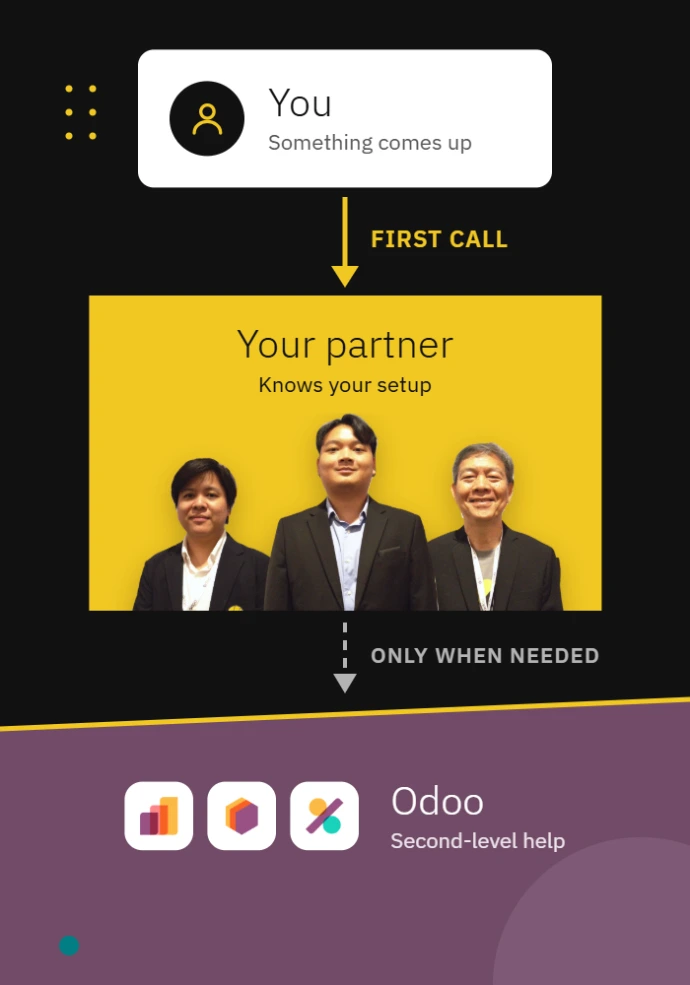
When something comes up
Your partner is your first call. When you work with a partner, Odoo's agreement makes the partner your main point of contact for bug fixes, support and upgrades, and support requests go through the partner. If the partner needs help with Odoo's standard features, it can go to Odoo for second-level assistance.
In practice, that's you, then your partner, then Odoo when needed. You explain the problem once, to people who know your setup.
Do you need a partner?
Not always, and Odoo says so itself. Its pricing page puts it by company size: companies with fewer than 50 employees often work with Odoo directly, using Success Packs; companies with more than 50 often work with partners who provide local project management; and companies with 250 or more are asked to contact Odoo.
Odoo's word is "often", and it's the right one. Size is a rough guide. If you have several branches, Thai tax to get right, other systems to connect or a team that works best in Thai, a local partner usually earns its place.
Looking for an Odoo partner?
We're CU Solution System. We don't do a little of everything. We do Odoo, completely: implementation, customization and support, in Thai and English. If you're weighing up Odoo, or you're already on it and unsure who should handle what, let's talk.